
Product-related certificates
Sustainability, quality, and transparency are key requirements in the construction industry. At Hörmann, these go hand in hand: We support architects, construction companies and engineering offices with certified products that provide planning security, ensure eligibility for subsidies and demonstrate ecological responsibility. Our overview shows which certificates we provide and what they can primarily be used for.
All certificates available for the respective product can be found at Mediacenter.
EPD (Environmental Product Declaration)
The EPD or Environmental Product Declaration is the basis for many building certifications. It documents the environmental impact of a product over its entire life cycle - transparently, in accordance with standards and independently tested. Hörmann provides EPDs for many products and thus offers important data for certification systems such as DGNB, LEED, or BREEAM. Our EPDs were created by ift Rosenheim in accordance with ISO 14025 and EN 15804. They are listed in the Ökobaudat of the Federal Ministry for Housing, Urban Development and Building (BMWSB).
- Awarded (Hörmann): ift Rosenheim
- Criteria: Life cycle analysis in accordance with ISO 14025 / EN 15804
- Focus: Life cycle assessment and environmental impacts
- Benefits: Data for DGNB ENV 1.1, LEED, BREEAM
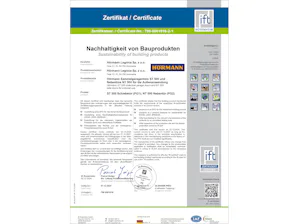
Product Passport for Sustainability
Hörmann offers sustainability product passports (NHPP) for all of our products that have an EPD, as well as for some others. These take into account environmental impact, service life and deconstructability and contain all the information required for DGNB or QNG certification - even going far beyond the ENV1.1 and ENV1.2 criteria. This simplifies the certification process and keeps costs for auditors low. The sustainability product passports (NHPPs) are also stored in the DGNB Navigator.
- Awarding (Hörmann):ift Rosenheim
- Criteria: Environment, service life, deconstruction, social aspects
- Focus: Product assessment for DGNB and QNG Certification
- Benefits: Facilitates verification for sustainable construction projects
DGNB Navigator Label
All Hörmann products with a sustainability product passport are listed in the DGNB Navigator. The online tool links product data directly to the requirements of DGNB certification and supports architects with digital planning and documentation. All the data stored in this database has already been checked and approved by the DGNB itself, so the auditor no longer needs to look at individual certificates.
- Awarded: DGNB
- Criteria: Transparent product data, EPDs, technical verifications
- Focus: Digital planning support, pre-qualification for DGNB certification
- Benefits: Individual certificates no longer necessary for auditors
- All Hörmann products with the DGNB Navigator label can be found here:Product database | DGNB GmbH
Manufacturer's declaration of conformity with the QNG Certification
With the manufacturer's declaration of conformity with the Sustainable Building Certification (QNG), Hörmann supports the implementation of eligible construction projects. The QNG Certification is a prerequisite for the promotion bonus as part of the “Climate-friendly New Builds” (KFN) program. It is not awarded to individual products, but to the entire building. It is therefore important to comply with specific material requirements - particularly regarding the avoidance of pollutants. Our manufacturer's declaration confirms that our products meet the relevant requirements of the QNG Certification requirements catalog and can therefore be used without hesitation in buildings eligible for certification.
- Awarded: Hörmann
- Focus: Avoiding pollutants
- Benefits: Simple verification of material requirements for eligible construction projects with the QNG Certification
Building certifications
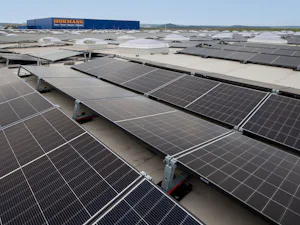
The product certifications and seals provided by Hörmann are important components of building certifications. They simplify the verification process, save time and money, and help to achieve many assessment points. The building certification systems require detailed evidence of the environmental impact and quality of the building products used - and this is precisely where our product certificates provide the necessary transparency.
What are building certifications?
Building certifications are standardized procedures for assessing the sustainability and quality of buildings. They provide an objective basis for assessing buildings in terms of their environmental compatibility, energy efficiency, conservation of resources, cost-effectiveness, and user-friendliness. Both new and existing buildings are considered - across all life cycle phases: from planning and construction through to use and dismantling.
Why are building certifications important?
Building certifications are an important competitive factor for planners, architects, investors and general contractors in the B2B sector. They increase the market attractiveness of real estate, improve rentability, and can ensure long-term value retention. Certified buildings also often meet the requirements of institutional investors and public clients who pay attention to sustainability and ESG criteria (environmental, social, governance).
What are the most important building certification systems?
BNB (Assessment System for Sustainable Building)
The BNB was developed by the Federal Ministry of Housing, Urban Development and Building. It is not a seal, but the official sustainability assessment system for the public sector in Germany and serves as the basis for the planning, assessment and certification of sustainable federal buildings. The ecological, economic, technical and socio-cultural qualities of a building are assessed - from planning and use to dismantling. The BNB is closely linked to the Quality Seal for Sustainable Buildings (QNG Certification, see below). For public clients, it is a key instrument for implementing sustainable building policy.
QNG – Sustainable Building Certification
The QNG Certification is a state sustainability seal developed by the Federal Ministry of Housing, Urban Development and Building (BMWSB). It is a prerequisite for federal funding for efficient buildings (BEG), enables KfW funding, and evaluates ecological, economic, and social aspects. The QNG is awarded according to the criteria of the BNB (see above).
DGNB – German Sustainable Building Council
The DGNB certification system evaluates buildings holistically - from ecology to economic efficiency and technical quality. There are different grades: Bronze, Silver, Gold, and Platinum. DGNB certification is versatile: it offers certification variants for different building types and project phases, including new buildings, existing buildings, buildings in operation, interiors (e.g. tenant fit-outs and working environments) and even entire neighborhoods and districts with sustainable urban development and mobility concepts.
LEED – Leadership in Energy and Environmental Design
LEED is awarded by the U.S. Green Building Council (USGBC) and is the world's most widely used green building rating system. It differentiates between new buildings and renovations, investor models, existing buildings and interior and tenant fit-outs. A version for entire communities or cities is also available. It rates buildings according to a points system in categories such as energy, water, materials and interior quality. Depending on the number of points achieved, a certification level from “Certified” to “Platinum” is awarded.
BREEAM – Building Research Establishment Environmental Assessment Method
BREEAM is the leading sustainability certificate in the UK. In German-speaking countries, it is awarded exclusively by TÜV Süd. Among other things, it looks at energy efficiency, choice of materials and waste management and rates buildings on a scale of zero to 100 points. Depending on the number of points achieved, the system awards one of five degrees of excellence for new buildings (existing buildings: six degrees of excellence).
